Behold Evertaster by Adam Glendon Sidwell. I am legitimately excited about this book.
Sure, it's written by a friend of mine, but as I'm currently reading it, I genuinely love it for its own merits. It is a genuinely exciting, funny adventure story. Multiple times I've turned to my husband and, laughing out loud, said, "I HAVE to read you this part..."
An unnaturally picky eater and his family go on a quest around the world in search of the ingredients for a legendary recipe, and there's culinary peril along the way. This is one of the few young adult/middle grade fantasy books out there that features a strong, capable, and present mother character. She's a major part of the action, and I really appreciate that. It's also squeaky-clean, family-oriented, and all kinds of clever.
Evertaster comes out June 14, and if you're not as lucky as I was to get your hands on a pre-release copy already, here's your chance to win one: enter the Evertaster Blogtopia Sweepstakes. You could win a copy of the book and an Amazon gift card.
Tasty, right?
I recommend art.
Paint, illustration, and whatever else I'm learning about.
Wednesday, May 23, 2012
Monday, August 22, 2011
For glory and for beauty
Friday, February 11, 2011
New Fine Doodles
It always takes a while to update the Fine Doodles gallery, but I wanted to share a few recent ones. Three of my favorites:
| Just look at those monsters. Just look at them! The only details I added were a bit of texture on the beasts and the faint clouds up top. This is the kind of stuff I drew as a kid. |
| There are just too many things to love about these crazy-limbed people. There was no background originally, but I like the way it turned out all together. |
Sunday, January 30, 2011
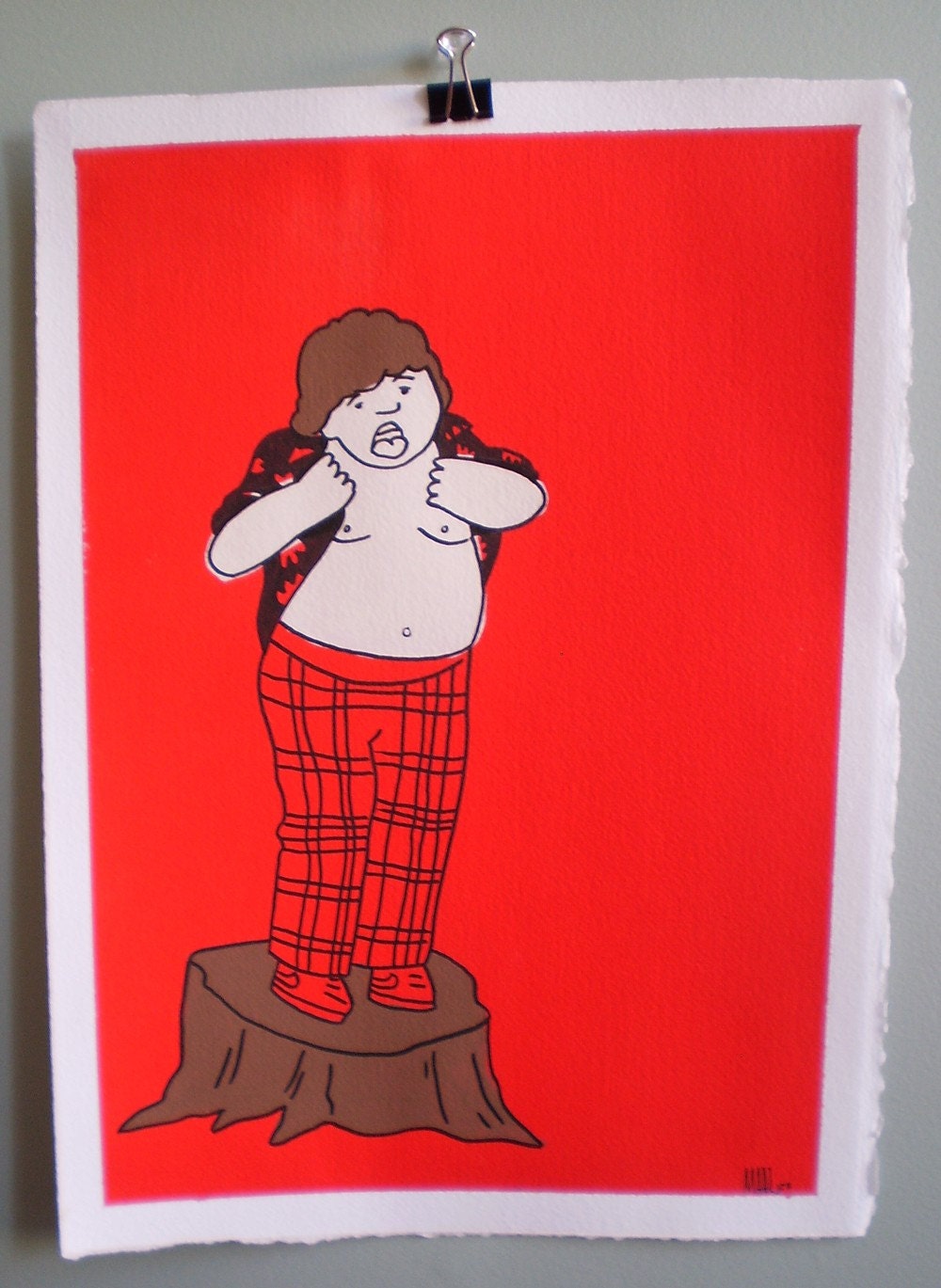
This is awesome
![]() |
| Goonies Chunk Truffle Shuffle, by Marz Jr.. |
Thursday, January 20, 2011
A preview of things to come
I've been working on a little illustration that I'm excited about. Here's a tiny section of it. If you can guess what's going on, I'll probably give you a million dollars.
More fantastic illustrators
Spending too much time on the internet has the wonderful effect of shoving me in the direction of too many illustrator's websites. I've stumbled upon the following talented people through various means - blog comments, Illustration Friday* archives, link hopping...several of them have that retro style I enjoy so much:
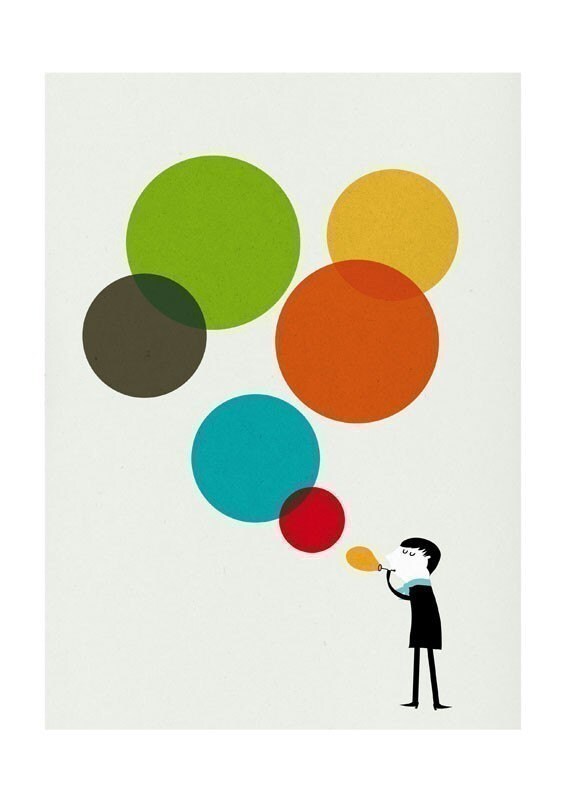
![]() |
| Monsieur IV, by Blanca Gomez of Cosas Minimas. Available here. Go look as her website. Just look at it. And then tell me you wish you didn't own every one of them, or better yet, you made them all yourself. |
![]() |
| This charming little vignette is titled Sneaky. It's by Vincent Desjardins, who generously explains his process on his blog. He gets the letter-press look with the aid of the help of Mr. Retro. Next time I have a hundred bucks to blow on a sweet Photoshop filter, I'm getting me one of those. Love that look. |
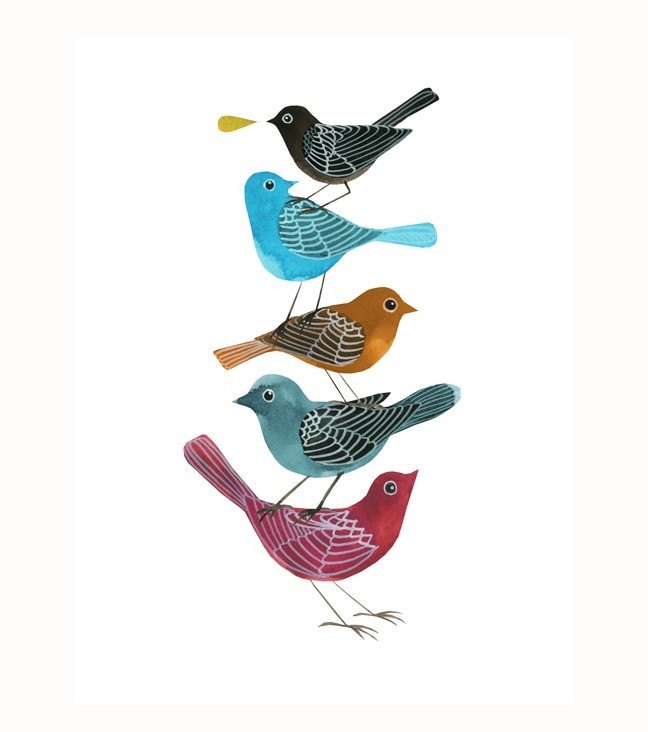
![]() |
| Stacked, by Gennine, who writes this enchanting blog. Available here. The bird motif has been so popular for so long, but hers still impress me. I think it's the graphic shapes mixed with organic textures, which I tend to love. *If you've never been to Illustration Friday, it provides a weekly prompt to which illustrators of all kinds respond. Fun browsing. |
Monday, January 17, 2011
A trip to the LACMA
One of my favorite things about Los Angeles is all of the museums, and one of my favorite things about the museums is that there's almost always some way to get in free. We signed up both of our kids for the LACMA NEXGEN program, which generously allows one free adult escort per child. And you can sign up any child under age 18, even a four-month-old who sleeps most of the time. So our whole family went for free!
This time, we visited the exellent pop art exhibit:
And then we toured the Richard Serra installations. Multiple times:
These giants are made of 12-foot-tall sheets of steel, and as you walk through them the curves lean at varying grades toward and away from you. At some points the open top is only a few inches wide and sometimes it's maybe ten feet. But the tilting is mostly subtle, gradual. So as you walk through your mind expects the walls to act like all of the walls you know, parallel and perpendicular in all the right places. But the negative space that surrounds you is always changing as you move forward, and I had an intense reaction to it my first time through. I felt dizzy, imbalanced, and what I imagine to be a little high. I don't know what that actually feels like, though, so take that with a grain of salt.
What I'm trying to say is that these are dang powerful pieces of sculpture.
This time, we visited the exellent pop art exhibit:
![]() |
| Huge, insane sculptures by Jeff Koons, image found here. |
And then we toured the Richard Serra installations. Multiple times:
![]() |
| A Richard Serra piece. It looks a lot like the one we visited (titled Sequence), and though my source for the image above indicates that it is, I'm not sure it is. |
![]() |
| Inside Richard Serra's Sequence, grabbed from flickr. |
These giants are made of 12-foot-tall sheets of steel, and as you walk through them the curves lean at varying grades toward and away from you. At some points the open top is only a few inches wide and sometimes it's maybe ten feet. But the tilting is mostly subtle, gradual. So as you walk through your mind expects the walls to act like all of the walls you know, parallel and perpendicular in all the right places. But the negative space that surrounds you is always changing as you move forward, and I had an intense reaction to it my first time through. I felt dizzy, imbalanced, and what I imagine to be a little high. I don't know what that actually feels like, though, so take that with a grain of salt.
What I'm trying to say is that these are dang powerful pieces of sculpture.
Monday, January 10, 2011
Four kids' books I want real bad
First, Antoine de Saint Exupery's The Little Prince is absolutely one of my favorite books of all time. And I have several copies of it. But then I found the big fat pop-up edition at a bookstore and just about wet my pants with excitement. I got to leaf through it, pull the tabs, watch the sunrises and sunsets over the little planets, watch the snake slither up...it's incredibly well-crafted. This will be put on the really-pretty-books-around-which-I-will-gather-my-well-behaved-children-for-meaningful-family-reading-time shelf.
![]() |
| Dinosaur vs. The Potty |
Second, my son and I have both been fans of Bob Shea's Dinosaur vs. Bedtime for a while. I haven't read Dinosaur vs. The Potty yet, but I'm confident it will be just as fun as the first. I'm hoping my son's enthusiasm for roaring like a dinosaur will carry over to enthusiasm for learning to use the potty.
![]() |
| LMNO peas |
Third, I just grabbed LMNO peas off the shelf at the library this weekend, and it's adorable! The illustrations are simple and sweet and the rhymes are the same.
![]() |
| Ellsworth's Extraordinary Electric Ears |
Last, I grabbed Ellsworth's Extraordinary Electric Ears on the same library trip, and it's fantastic. It's a bit of an alphabetical I-spy book, like Graham Base's Anamalia and so many others, but it's so clever and simple. The page for X made me particularly happy, though so many other alphabet books seem to struggle with that one. The humor and the aesthetic also remind me of A Town Called Panic*, which is always a plus.
* If you've never seen A Town Called Panic, please go watch it right now. It's French, it's hilarious, and it's available on Netflix Instant Watch.
Saturday, January 8, 2011
A question about the preparation process
In this post about gouache, I was asked the following question: "What is your prep process before you start painting? Do you sketch it out in pencil? Do you believe in tracing?"
I absolutely believe in tracing.
Not all the time. Strictly in terms of portraiture tracing is awfully convenient, because drawing an accurate and recognizable face takes me far more time than I can afford. A project for school or for sale or something where I feel like I need to achieve some level of purity, sure, I'll hand draw it. But for something quick and small-time (like these, for instance), I'll trace.
For things outside of portraiture I also sketch ahead of time, but only very lightly and loosely to get a sense of composition and proportion. I rarely bother hiding my pencil lines, and you can see them in just about all my work, which manifests both my laziness and my aesthetic sense. In case I needed to say it plainly, I don't hold myself to a strict academic standard.
For Fine Doodles, I always trace due to the nature of the project. I digitally scale the original child's drawing to the size of my board, print it, tape it on one side of the board so I can fold it out of the way without losing placement between paint layers, and slip a sheet of tracing paper between them. I use Loew Cornell Transfer Paper (which I purchase through Dick Blick). I've used other brands (Sally's is terrible), and Loew Cornell is by far my favorite. I use the white kind whenever possible, as I find it to be less prone to flaking and smudging than the grey.
As for other preparatory steps, I almost always tone my support ahead of time. ("Support," if you're not in the know, is the word they use in art classes for "the thing you paint on.") Whatever is underneath will show through (whether through transparent layers or through the way you interact with the colors as you paint), so when you start with a white surface, your painting tends to look...white. Washed-out. So I give my support a thin layer of a mood color - often a neutral. If I'm working with a transparent medium, like watercolor, I have to think ahead and put frisket on whatever highlights I want to remain white.
If you're wondering what frisket is...remember the art project in elementary school where you slap down some rubber cement on your paper, put some ink or paint over the top, and then peel up the rubber cement to reveal the paper again? Frisket is that.
My only other preparatory steps are stretching any necessary paper and taping off the painting area. Leaving a nice white paper border around your painting (via tape) is the convention for aqueous media, and it just looks pretty.
I absolutely believe in tracing.
Not all the time. Strictly in terms of portraiture tracing is awfully convenient, because drawing an accurate and recognizable face takes me far more time than I can afford. A project for school or for sale or something where I feel like I need to achieve some level of purity, sure, I'll hand draw it. But for something quick and small-time (like these, for instance), I'll trace.
![]() |
| Study of a live model from my figure-painting class in college. Oil on board. Toned background and visible pencil lines? Yes please. |
For Fine Doodles, I always trace due to the nature of the project. I digitally scale the original child's drawing to the size of my board, print it, tape it on one side of the board so I can fold it out of the way without losing placement between paint layers, and slip a sheet of tracing paper between them. I use Loew Cornell Transfer Paper (which I purchase through Dick Blick). I've used other brands (Sally's is terrible), and Loew Cornell is by far my favorite. I use the white kind whenever possible, as I find it to be less prone to flaking and smudging than the grey.
As for other preparatory steps, I almost always tone my support ahead of time. ("Support," if you're not in the know, is the word they use in art classes for "the thing you paint on.") Whatever is underneath will show through (whether through transparent layers or through the way you interact with the colors as you paint), so when you start with a white surface, your painting tends to look...white. Washed-out. So I give my support a thin layer of a mood color - often a neutral. If I'm working with a transparent medium, like watercolor, I have to think ahead and put frisket on whatever highlights I want to remain white.
If you're wondering what frisket is...remember the art project in elementary school where you slap down some rubber cement on your paper, put some ink or paint over the top, and then peel up the rubber cement to reveal the paper again? Frisket is that.
My only other preparatory steps are stretching any necessary paper and taping off the painting area. Leaving a nice white paper border around your painting (via tape) is the convention for aqueous media, and it just looks pretty.
Thrown out there by
Summer Myers
at
9:53 PM
No comments:
Labels:
Drawing,
Paint,
questionandanswer,
Reviews,
Technique
Some of my favorite illustrators
I'm a trend-follower; I'm just as in love with the flat, graphic 1950's/1960's illustration style as the rest of the world. Here are some of my favorites:
First, from the actual 1950's and 1960's, we have Jim Flora and Charley Harper. Just check out those shapes!
Then we have two contemporary illustrators who have some of that same flair, Ward Jenkins and the ever-stylish Matte Stephens. Yes, I am a Mad Men fan:
First, from the actual 1950's and 1960's, we have Jim Flora and Charley Harper. Just check out those shapes!
![]() |
| From Jim Flora's Kangaroo for Christmas, via here. |
![]() |
| By Jim Flora, via this place. |
![]() |
| From Charley Harper's ABCs, via this place. |
![]() |
| From a Charley Harper book, via this place. |
Then we have two contemporary illustrators who have some of that same flair, Ward Jenkins and the ever-stylish Matte Stephens. Yes, I am a Mad Men fan:
![]() |
| Ultimate Mad Men Party, Ward Jenkins |
![]() |
| Daytripping, Ward Jenkins |
![]() |
| Matte Stephens, via Spraygraphic. |
![]() |
| By Matte Stephens, via Monkeyama. If you dig this stuff just as much as I do, take a look at grain edit, a blog dedicated to 50's and 60's era modern illustration. |
Subscribe to:
Posts (Atom)